
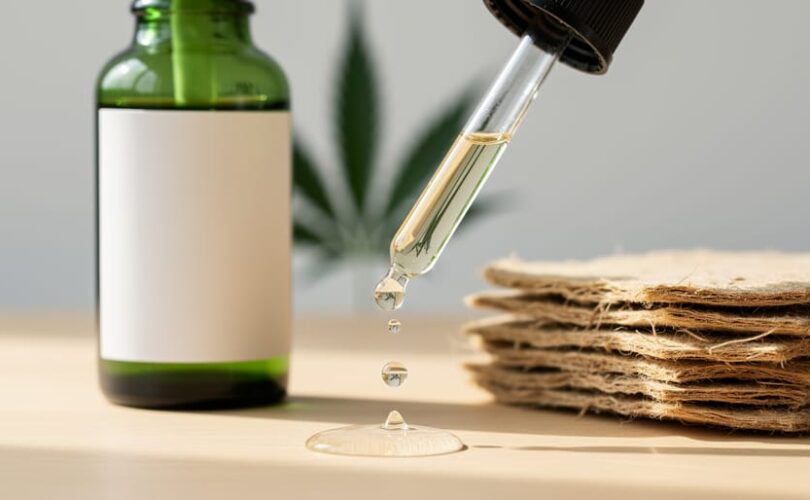
0.03% THC refers to an ultra-low concentration of tetrahydrocannabinol, ten times lower than the 0.3% federal hemp limit established by the 2018 Farm Bill. If you’ve been searching for this specific number, you’re likely either trying to clarify the actual legal standard or looking for products with virtually no psychoactive potential whatsoever.
The confusion is understandable. Many people misremember the federal threshold as 0.03% when the legal limit for hemp is actually 0.3% THC by dry weight. That extra zero makes a significant difference. At 0.03%, we’re talking about trace amounts so minimal they exist only in highly refined isolates, specific breeding projects, or manufacturing processes designed to strip THC to near-undetectable levels.
Why would anyone want THC levels this low? Some consumers need absolute certainty they won’t experience any psychoactive effects, whether for workplace drug testing, personal sensitivity, or therapeutic applications where even the standard hemp threshold feels like too much. Athletes subject to strict anti-doping protocols, professionals in safety-sensitive positions, and individuals with THC sensitivity often seek these ultra-refined options.
This article will clarify the difference between 0.03% and the actual 0.3% legal standard, explain what products genuinely fall into this ultra-low category, and help you understand when such extreme refinement makes practical sense for your needs. We’ll cut through the regulatory confusion and give you a clear picture of what 0.03% THC really means in the hemp and CBD landscape.
What 0.03% THC Actually Means
When you see “0.03% THC” on a product label, you’re looking at a concentration that contains three-hundredths of one percent tetrahydrocannabinol by dry weight, roughly one-tenth the amount allowed under U.S. federal hemp law. This ultra-low threshold sits far below the 0.3% THC limit that defines legal hemp in the United States, representing a formulation choice made by manufacturers targeting consumers who want the absolute minimum psychoactive compound present.
- 0.03% THC
- An ultra-low concentration containing 0.3 milligrams of THC per gram of product by dry weight, ten times lower than the federal hemp threshold.
- 0.3% Federal Threshold
- The maximum THC concentration allowed in hemp under the 2018 Farm Bill, measured as delta-9 THC on a dry weight basis.
- Delta-9 THC
- The primary psychoactive cannabinoid in cannabis, regulated by weight percentage in hemp products.
- Dry Weight Basis
- The measurement standard excluding moisture content, used to calculate THC percentage in compliance testing.
- Non-Detectable THC
- Products formulated to contain zero measurable THC, typically using pure CBD isolate rather than 0.03% formulations.
To put 0.03% in perspective, recreational cannabis products typically contain 15-30% THC, making them 500 to 1,000 times more concentrated than products at this ultra-low threshold. Even standard CBD products formulated at the legal 0.3% limit contain ten times more THC than 0.03% products. This fraction matters most in international markets with stricter limits (some European countries cap THC at 0.2% or lower), workplace wellness programs with zero-tolerance policies, and formulations designed for sensitive populations like first-time users or pets.
You’ll encounter 0.03% specifications primarily in CBD isolate-based products, broad-spectrum formulations with enhanced THC removal, and products manufactured for export to countries where 0.3% exceeds local regulations. It’s not a regulatory standard, it’s a voluntary manufacturing target that answers demand for trace-THC exposure without going fully THC-free.
How 0.03% THC Works in the Body
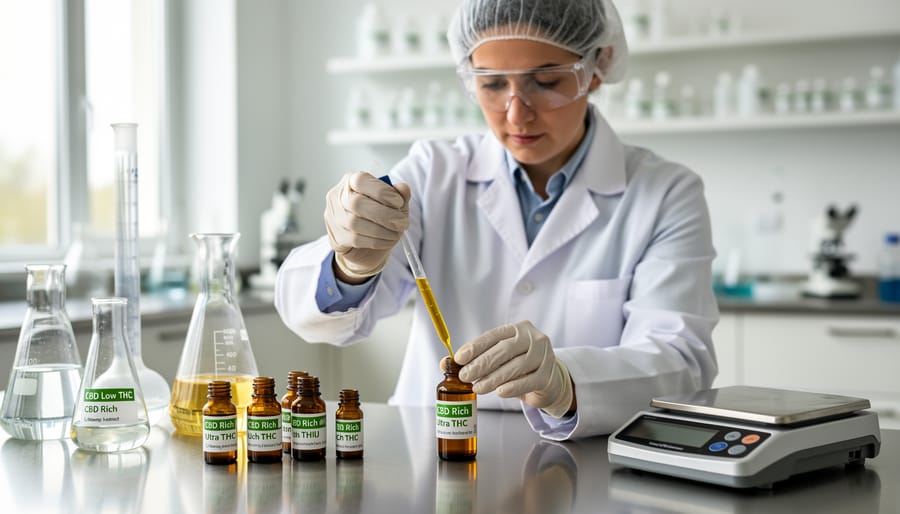
At 0.03% concentration, THC exists in such trace amounts that it barely registers with the CBD endocannabinoid system. To understand how THC interacts with CB1 receptors in the brain and nervous system, you need meaningful concentration, and 0.03% falls well below the threshold for noticeable psychoactive effects. While the federal hemp limit of 0.3% already produces minimal psychoactivity, 0.03% represents one-tenth that amount.
When you consume a product with 0.03% THC, your liver metabolizes it through the same pathways as higher concentrations, but the actual quantity is so small that it creates negligible impact. A 1,000mg CBD tincture at 0.03% THC contains just 0.3mg of THC total, roughly 1/17th of what you’d find in a standard 5mg THC edible. Your body processes this trace amount quickly, typically clearing it within hours without accumulation in fatty tissues at detectable levels.
The real value in 0.03% products often comes from what accompanies that minimal THC. Many formulations at this threshold feature CBD as the dominant cannabinoid, along with CBG, CBN, or other minor cannabinoids that work synergistically. This interplay, known as the entourage effect, suggests that even trace THC can enhance the overall therapeutic profile without contributing psychoactivity. The minuscule THC presence may help CBD bind more effectively to receptors, potentially boosting anti-inflammatory or calming effects.
For most users, the difference between 0.03% and zero THC is functionally identical in terms of how you feel. The concentration is simply too dilute to cross the psychoactive threshold, making these products suitable for anyone concerned about even the slightest mental alteration.
Different Forms of 0.03% THC Products
Manufacturers formulate products at this ultra-low 0.03% THC threshold through multiple pathways, each designed to deliver cannabinoid benefits while minimizing THC presence to a fraction of the already-minimal 0.3% federal hemp standard. These products aren’t widely marketed with “0.03% THC” as a label claim, but they exist in formulations engineered for maximum THC reduction where even trace amounts matter.
CBD isolate products naturally fall into this range or lower, since isolate processing strips away all other cannabinoids, including THC, often resulting in non-detectable levels or concentrations well below 0.03%. Broad-spectrum formulations represent the more complex approach: manufacturers start with full-spectrum hemp extract, then employ additional chromatography rounds, distillation refinement, or proprietary THC-stripping techniques to preserve beneficial cannabinoids like CBG and CBN while driving THC down to this ultra-conservative threshold. Some brands use these enhanced-removal processes specifically to serve international markets or institutional buyers with zero-tolerance policies.
Common product categories formulated at or near this level include:
- THC-free CBD oils and tinctures marketed for workplace wellness or drug-test concerns
- Topical creams and balms where THC contributes nothing to localized relief and may trigger regulatory complications
- Pet wellness products, since veterinarians and pet owners often prefer the lowest possible THC exposure for animals
- Corporate wellness offerings designed for employees in safety-sensitive positions
- Export-grade formulations meeting stricter international thresholds in Europe, Asia, and other markets
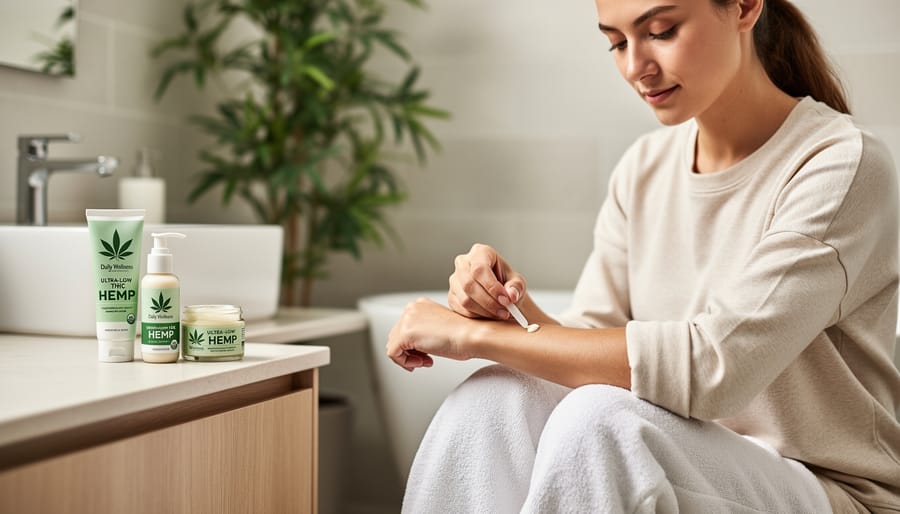
Topicals deserve special mention: since THC doesn’t penetrate the bloodstream through intact skin, many formulators intentionally reduce it to negligible levels, making 0.03% or lower a practical choice that simplifies compliance without sacrificing efficacy. Similarly, beverage and food manufacturers sometimes target this range to avoid any psychoactive perception, even theoretical, especially when marketing to conservative demographics or institutions with strict substance policies. The trade-off is that entourage-effect proponents argue minimal THC presence enhances CBD’s therapeutic impact, making ultra-low formulations potentially less effective than 0.3% products, a debate that ultimately comes down to individual response and risk tolerance.
Where and How 0.03% THC Products Are Used
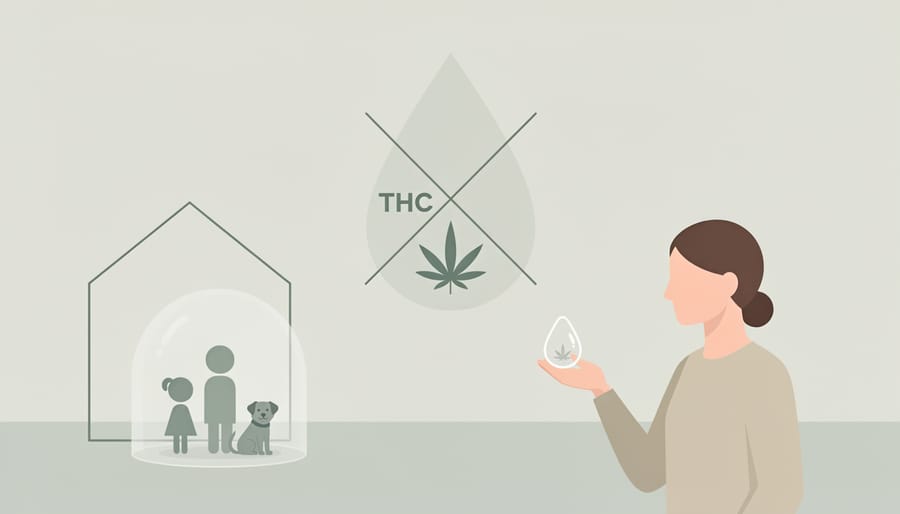
Products with 0.03% THC occupy a niche yet meaningful space in the hemp market, serving consumers and contexts where even the standard 0.3% federal threshold creates risk or discomfort. These ultra-low formulations aren’t about legal compliance, they address practical scenarios where trace THC matters beyond regulatory minimums.
Common Use Cases for 0.03% THC Products:
- Workplace wellness programs with zero-tolerance drug policies or safety-sensitive positions
- European and Middle Eastern markets where THC limits often range from 0.2% to zero
- Athletes subject to World Anti-Doping Agency rules or organizational drug testing
- First-time users and elderly individuals seeking CBD benefits without any psychoactive concern
Professional environments drive significant demand. Nurses, commercial drivers, law enforcement officers, and military personnel face career consequences from positive drug screens, even when using legal hemp. A 0.03% product reduces (though doesn’t eliminate) detection risk compared to standard 0.3% formulations, particularly for daily users or those with slower THC metabolism.
International commerce presents another driver. Countries like Switzerland cap hemp-derived THC at 0.2%, while others maintain stricter thresholds. Brands targeting global distribution often formulate at 0.03% or below to clear the lowest common denominator, simplifying compliance across multiple jurisdictions without maintaining separate product lines.
Sensitive populations, pregnant women consulting with healthcare providers, individuals on medications with cannabinoid interactions, or those with THC sensitivity or anxiety histories, may prefer the reassurance of near-zero THC. For these users, the psychological comfort matters as much as the physiological reality. Parents introducing elderly relatives to CBD for arthritis or sleep often start here, where explaining “basically no THC” proves easier than navigating the 0.3% conversation.
0.03% vs. 0.3%: Understanding the Legal Distinction
The 0.3% threshold is the established U.S. federal standard under the 2018 Farm Bill, hemp must contain no more than 0.3% delta-9 THC by dry weight to remain legal. This isn’t negotiable or variable; it’s the line separating legal hemp from controlled cannabis. Products labeled at 0.03% THC represent a voluntary manufacturer choice to formulate at one-tenth of the legal limit, not a separate regulatory category.
Why do some companies aim this low? Several practical reasons drive ultra-conservative formulations. Manufacturers serving international markets often need to meet stricter thresholds, some European countries impose 0.2% limits, while others require near-zero THC. Companies selling to institutional buyers (corporate wellness programs, nursing facilities) frequently choose 0.03% to provide extra buffer against liability concerns. Brands targeting consumers who face workplace drug screening may market these ultra-low products as “extra safe,” though no THC level guarantees passing a sensitive test.
Testing variability also plays a role. Hemp testing involves analytical uncertainty, and results can fluctuate slightly between labs or sample batches. A product formulated at exactly 0.3% risks occasional test results slightly above the limit due to natural plant variation or measurement error. Building in a 0.27% buffer provides manufacturing cushion, ensuring consistent compliance even with testing fluctuations.
Internationally, the regulatory landscape varies dramatically. Switzerland allows 1.0% THC, while countries like Sweden maintain nearly zero-tolerance policies. Some Asian markets prohibit any detectable THC, making 0.03% formulations, or pure isolates, the only viable options for global brands. Understanding how these ultra-low concentrations interact with endocannabinoid system basics helps explain why even trace amounts can satisfy regulatory requirements while maintaining product functionality.
The key distinction: 0.3% is law, 0.03% is strategy.
Common Questions About 0.03% THC
Will a product with 0.03% THC show up on a drug test? It’s unlikely but not impossible, standard workplace screenings look for THC metabolites, and while this ultra-low concentration is ten times below the 0.3% federal hemp limit, repeated high-dose use could theoretically accumulate enough trace amounts to trigger a positive result. If you’re subject to zero-tolerance testing, a true THC-free isolate is the safer bet.
Will 0.03% THC show up on a drug test?
Unlikely, but possible with very high doses or frequent use. Standard tests target THC metabolites, and this ultra-low concentration minimizes risk compared to 0.3% products, though zero-THC isolates remain safest for zero-tolerance scenarios.
Is 0.03% THC less effective than 0.3% products?
Not necessarily, therapeutic effects come primarily from CBD and other cannabinoids, not the trace THC. Both concentrations offer similar benefits for most users, though some prefer the slight entourage effect from 0.3% formulations.
Where can I find 0.03% THC products?
These ultra-low formulations are less common than standard 0.3% hemp products but appear in brands targeting international markets, workplace wellness programs, or consumers seeking maximum THC reduction. Look for lab reports showing enhanced THC removal.
Why choose 0.03% over completely THC-free products?
Some users want trace cannabinoids for a minimal entourage effect without the complete isolation of pure CBD. It’s a middle ground between broad-spectrum formulations and isolates, offering slight synergy with near-zero psychoactive effects explained.
Effectiveness isn’t compromised at this threshold, CBD, CBG, and other non-intoxicating cannabinoids drive most therapeutic outcomes, whether you’re using 0.03% or 0.3%. The difference matters more for regulatory compliance, drug-test caution, or personal comfort than for actual benefit. Cost varies by manufacturer: some brands charge a premium for enhanced THC removal, while others price these formulations identically to standard broad-spectrum offerings since the difference comes down to sourcing and processing techniques rather than ingredient expense.
Understanding 0.03% THC helps you navigate an increasingly nuanced hemp market. While the federal hemp standard sits at 0.3% THC, products formulated at 0.03%, ten times lower, serve specific needs: international markets with stricter limits, consumers facing drug testing, workplace wellness programs, and individuals who want the benefits of cannabinoids with virtually zero psychoactive risk. This ultra-low threshold isn’t a regulatory requirement but a formulation choice that manufacturers make to reach audiences where even trace THC matters.
Your ideal hemp product depends on your circumstances. Consider your local regulations, testing requirements, personal sensitivity to THC, and therapeutic goals. A 0.03% product won’t differ dramatically in CBD benefits from a 0.3% option, but it offers added peace of mind in situations where any detectable THC could be problematic. As the hemp industry matures, expect more precision in labeling and more options across the THC spectrum, from zero-THC isolates to carefully calibrated trace amounts.
What cannabinoid profile works best for your lifestyle? Share your experiences with ultra-low THC products in our community forums, where real users discuss what formulations deliver results without complications.


